Alfred North Whitehead’s process philosophy presents peace as an ongoing process rather than a static goal or an opposition to war. It emphasizes interconnectedness and the deep harmony of the universe, as a process moving toward aesthetic and metaphysical unity. Whitehead argues that peace, linked to adventure, art, beauty, and truth, cannot be achieved through control or commandments but requires an expansion of eros and an understanding of tragedy as linked to youth. His personal loss during World War One shaped his perspective on peace, highlighting the importance of empathy and ethical commitment in realizing peace. In the Conclusion of the post I propose the image of the former Italian-Austrian cemetery of Val Magnaboschi in Cesuna di Roana -Altopiano dei Sette Comuni, near Asiago, Italy, as a visual allegory of Whitehead’s idea of peace.
Whitehead’s Idea of Peace
Alfred North Whitehead’s “process philosophy” inspires a dynamic idea of peace that is not considered an essence or a goal to achieve. It does not stand in opposition to war. Instead, it appears to be a method, a process, or an event of continuous becoming by which humans learn to comprehend the tragic dimension of the life of the universe and their position in it. The reality at the center of process philosophy has nothing static; every element that constitutes it connects to all the others, and only in the relationships receives an identity that is always in movement, constantly changing. This philosophy appears as an antidote to every ideological fundamentalism, including the warmonger or the pacifist one. For what concerns peace, Whitehead clarifies that “the deliberate aim at Peace easily passes into its bastard substitute, Anaesthesia.” For him, peace is a harmony of the soul that reconciles the opposites of life going beyond them, enriching human experience and the appreciation of existence. Anesthesia, on the contrary is only preoccupied with avoiding the opposites of life and the pain that come with them. It degrade the full experience of peace in something false and inauthentic. Thus, Whitehead suggests that the experience of Peace is mainly beyond the control of purpose, as “it comes as a gift,” a moment of grace, which is not under the authority neither of humans nor of gods traditionally conceived.


What is striking in this idea of peace is the refusal to consider it a consequence of the inhibitions and restrictions imposed by humans or commandments dictated by a divinity. The experience of peace can only be realized through an expansion of desire. That is why peace is linked to Whitehead’s qualities essential to the civilized world: Adventure, Art, Beauty, and Truth. It is no coincidence that he discusses peace in the last chapter of his Adventures of Ideas (1933) as the crowning of the other qualities, as “the harmony of harmonies,” which lies at the heart of the nature of things. Toward the end of the peace essay, Whitehead explains that the actual concept of “civilization” remains inherently incomplete and related to “transcendence,” the feeling, the enthusiasm, the energy, and the “eros” necessary for adventure and peace. In other words, Peace requires a “coordination wider than personality” and needs to conceive the unity of all things in the Universe: “This feeling requires for its understanding that we supplement the notion of Eros by including in it the concept of Adventure in the Universe as One” (295). He goes on to explain that this “Adventure” embraces all possible occasions but does not coincide with any of them: “The Unity of Adventure includes the Eros, which is the living urge towards all possibilities, claiming the goodness of their realization” (ibid).

Youth and tragedy
For Whitehead, youth “is peculiarly liable to the vision of that Peace, which is the harmony of the soul’s activities with ideal aims that lie beyond any personal satisfaction” (288). It is as if youth contained within itself all the potentialities of the universe’s life, expressing itself at first with the force of an undivided eros devoid of utilitarian ends, which has nothing to do with personal love. Civilizations are preserved from this original force and by the widespread sense that there are high aims worthwhile in themselves. In this perspective, a sense of harmony, peace, and personal gratification arises from aim beyond personality. Youth is the incarnation of such undivided force open to all “ideal possibilities,” including the tragic ones, and the “intuition of permanence” of such possibilities. From this intuition, peace comes to light. Ultimately, the sense of peace derives precisely from the union of youth and tragedy.
Whitehead does not define peace but underlines that “the meaning of Peace is most clearly understood by considering it in its relation to the tragic issues which are essential in the nature of things.” This statement is to be placed in a process-oriented reality emphasizing interconnectedness that has the earth, the world, and the universe in mind. This is the broad context of the tragic dimension that Whitehead speaks of. It is a holistic metaphysics that, in today’s philosophical debates, can support current areas such as ecological civilization, sustainability, and environmental ethics. Whitehead philosophy is an invitation to broaden our attention beyond anthropocentric constraints and human history to realize the tragic dimension of the life of the Cosmos. From this perspective, peace cannot be a final state, something that is possible to achieve; it is a way of becoming that values continual effort, creativity, and ethical commitment.
Similarly to Heraclitus’s pre-Socratic philosophy of constant change and harmony as the result of the unity of opposites, Whitehead values the idea of “concrescence,” where there are not separate substances but related, diverse, at times opposite entities in permanent flux. Ultimately, in this context, “Peace is the understanding of tragedy, and at the same time, its preservation” (286). By maintaining an open and vivid sensitiveness to tragedy, youth gives evidence to the profound nature of things, such as the “harmony of harmonies” that comes from the perception of life’s vital, absolute, and unpredictable continuity.

The death of his son Eric in action during World War One contributed to the development of Whitehead’s ideas on peace. It confirmed the tragic vision of human life imbued with pain and suffering. Only the ability to feel a deep empathy for this dimension of life can lead to understanding the meaning of peace. The death of his son confirmed Whitehead’s belief that if it is true that the processual reality of life, war, and peace lies beyond the personal dimension, it is also true that individual death confirms the uniqueness of human life and its connection with that of the cosmos. Eric is buried at the Chauny Communal Cemetery British Extension in France, where his grave is marked with a special memorial.

Conclusion: An allegory of peace
I would like to conclude this post with a reference to another cemetery from the First World War that embodies with a strong allegorical power the tragic dimension of young lives broken by war and alludes with a visionary power to peace as the “harmony of harmonies,” the harmony of the universe, as a complex and contradictory process moving toward aesthetic and metaphysical unity that Alfred Whitehead speaks of. This is the former Italian-Austrian cemetery of Val Magnaboschi in Cesuna di Roana -Altopiano dei Sette Comuni, near Asiago, Italy. It is located in front of the “British Cemetery,” which is in the same area. It represents one of the best examples of conservation of historical sites for the Memory of the Fallen in the Great War. While the bodies of the soldiers have long been transferred to the Military Shrine in Asiago –one of the most important ossuaries of the First World War– in the former Italian-Austrian cemetery, some stumps of fir trees have been planted in place of the usual crosses. They were collected from nearby Mount Lemerle, the epicenter of bloody fighting in the summers of 1916 and 1918. As the Asiago guide Massimiliano Gnesotto suggested during a visit to this cemetery in September 2024, the trunks of the fir trees were cut and broken after twenty years, like the lives of the young soldiers fighting in World War One. On the broken trunks, painted white –the color of peace, purity, humility, innocence, and silence– metal plaques were placed to commemorate the first burials of many soldiers, including many unknown ones.
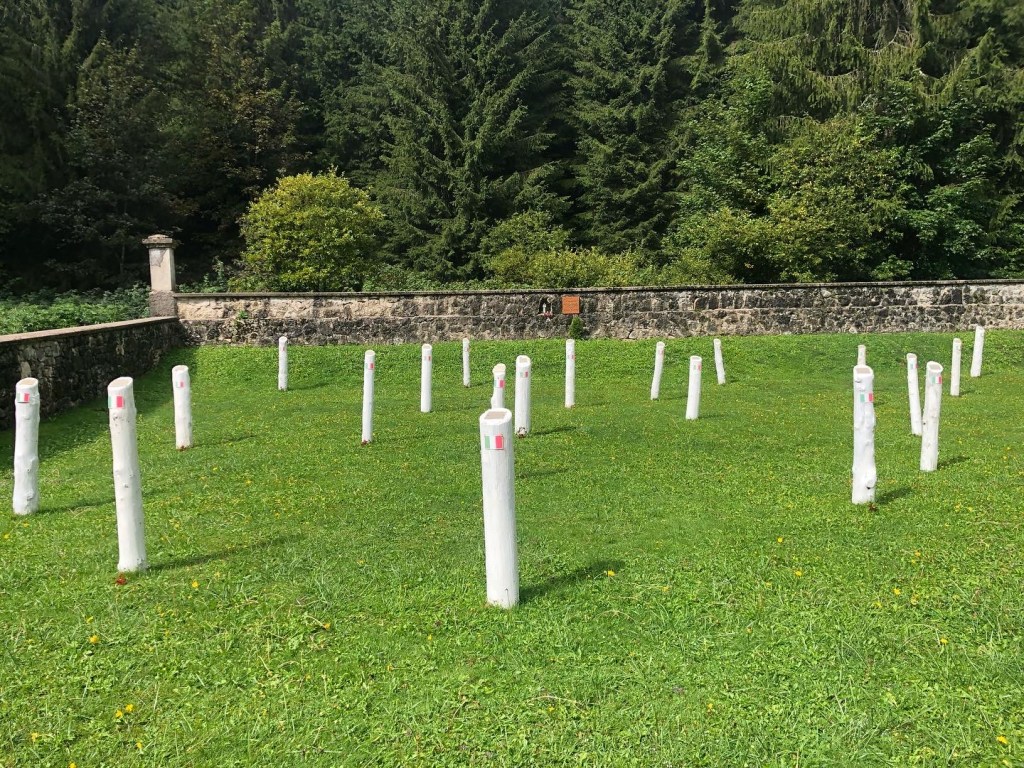
Photo by the author.
I visit this cemetery as part an interdisciplinary study program exploring, among other things, the Asiago plateau where Emilio Lussu, the author of A Soldier on the Southern Front (Un anno sull’Altopiano), fought during WW1. We combine the Earth Sciences and the Human Sciences, connecting the study of the historical events of WW1 to a broader temporal perspective, that of the ecology of the region and deep time of geology. This attention to the dual, intersected dimension of historical time and deep time educate us to see the interconnectedness of everything and how nature mirrors human history and at the same times reclaims it as part of the life of the universe. This lesson that we partially learn from field experience, can be associated to Whitehead process philosophy. It is the lesson that the soldiers of WW1 learned in the trenches and emerge in their testimonies and diaries.
For instance, Giani Stuparich mentions in his 1915 War diary the intersection of the trench soldier with the earth and nature. Moreover, the writer from Trieste, returning after the war to the Asiago Plateau where he fought together with his brother Carlo in 1916, asked himself whether it is nature or humans that gives shape to the universe: “Is it nature that dominates us or are we who dominate nature?” (Stuparich 2001, 637). The memory of so many lost lives, of the bloodshed on the meadows of the Plateau, must in the present make way for the observation that nature is erasing the memories of those destructions and remains the same, imposing itself on historical memory. Even the tiny country cemeteries visited by Stuparich appear incorporated into the earth and dominated by natural scenes, with cows grazing or potatoes growing in those same places where the soldiers’ blood was shed. Although a park of remembrance was created in those places, what strikes Stuparich is precisely the image of a nature that is indifferent and always the same regardless of human wars and suffering.
Bibliography
Jackson, Myron. “The Eros and Tragedy of Peace in Whitehead’s Philosophy of Culture.” Essays in the philosophy of humanism 23.1 (2015): 93–122. Web.
Stuparich, Giani. 2001. “Pellegrinaggi ai campi di battaglia”. In 1915-1918: La Guerra Sugli Altipiani: Testimonianze Di Soldati Al Fronte. 2. ed. Edited by Mario Rigoni Stern, and Attilio Frescura Vicenza: N. Pozza. 637-640.
Whitehead, Alfred North. Adventures of Ideas. 1st Free Press pbk. ed, New York: The Free Press, 1933.
Zap, Yuri, “how to see Leonardo.” Adobe Sock. Education licence.


 Massimo Lollini
Leave a comment