Humans, Geo-history, and deep time
The idea of peace born within the Process Philosophy, as described in the post Peace, Process Philosophy, and Youth’s Tragedy, seems to be the most adequate way to understand the problems of peace and war in the era that we have learned to call the Anthropocene. This era is characterized by significant instability of the concepts and theories we use to explain human life and the very idea of what is human. The first instability introduced by the concept of Anthropocene is the notion of nature and its relationship with culture. Not only does the concept of nature as a superior idea that holds the laws regulating life on earth enter into crisis but also its separation from the so-called culture. With climate change awareness, humans find themselves immersed in the tragic dimension of Geo-history and unable to write their past as a solely human endeavor. Comparing the deep time of the long history of the planet and the short history of human beings produces a double and contradictory effect. On the one hand, we realize the insignificance of humanity in the face of the vast history of the Earth, as ancient philosophers did. On the other hand, we also understand that humanity has the weight of unprecedented geological power on its shoulders (Latour, 50).
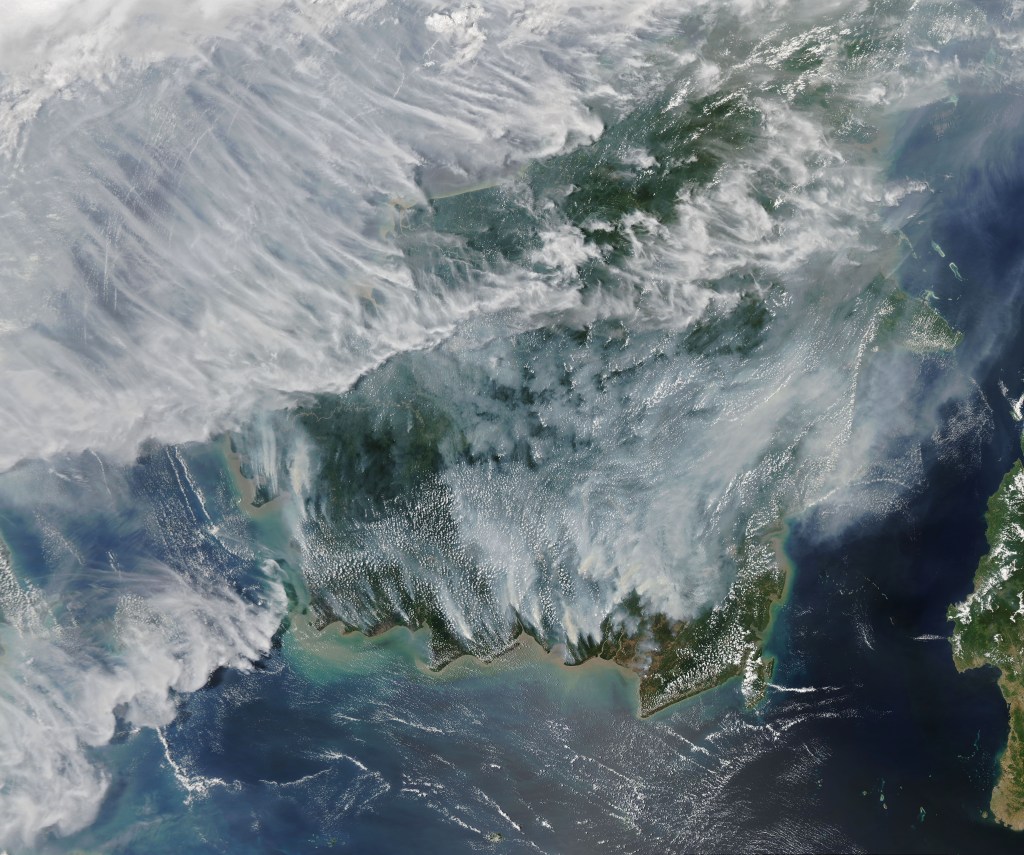
On one side, the awareness of deep time –the billions of years that shaped Earth before and beyond us –dissolves the illusion of human centrality. As ancient philosopher Heraclitus would say, we humans are momentary forms within an eternal process of transformation in a cosmos governed by the indifferent play of an ever-living Fire where creation and destruction are intertwined without reasoned design (Fragments DK 30 and DK 52). The ancient sense of awe before the cosmos reminds us that we are participants, not masters, of a world that precedes and will outlast us.
Yet, at the same time, and this is something ancient philosophers could not anticipate, the Anthropocene confronts us with a paradoxical truth: our species, despite its smallness in time and scale, now displays planetary power capable of altering the climate, oceans, and atmosphere. Ancient philosophers intuited that human arrogance and moral disorder could disrupt the harmony of the cosmos, Hesiod, for instance, in Works and Days), speaks of the Ages of Man degenerating from the Golden Age to the Iron Age, where injustice and greed destroy harmony between humans and gods. However, ancient philosophers could not imagine that this disruption would one day take physical form. In the Anthropocene, that old moral metaphor has become literal: our ethical failures now inscribe themselves upon the Earth’s climate, oceans, and air. The recognition of our insignificance must therefore coexist with the recognition of our significant agency.
This tension –between cosmic irrelevance and moral responsibility– invites a new kind of wisdom: not the illusion of control, but an ethic of participation and care within the living, evolving Earth. It asks us to inhabit Heraclitus’s insight that “the way up and the way down are one and the same,” (Fragment DK 60), to see that every act of creation or consumption, every spark of progress, carries within it the potential for both renewal and ruin. It expresses Heraclitus idea of unity of opposites – that opposing forces or directions are not truly separate, but different manifestations of a single underlying process. In short, it teaches us that to live well in the Anthropocene is to hold beginning and end together in consciousness –to act as though our small moment matters, precisely because it is part of the interdependent processes of the cosmos.
A recent poem, captures with new and great efficacy humans’ entanglements with Geo-history, deep time, and the cosmos. This poem was inspired by the “Cosmic Cliffs” image of the Carina Nebula captured by the James Webb Space Telescope.
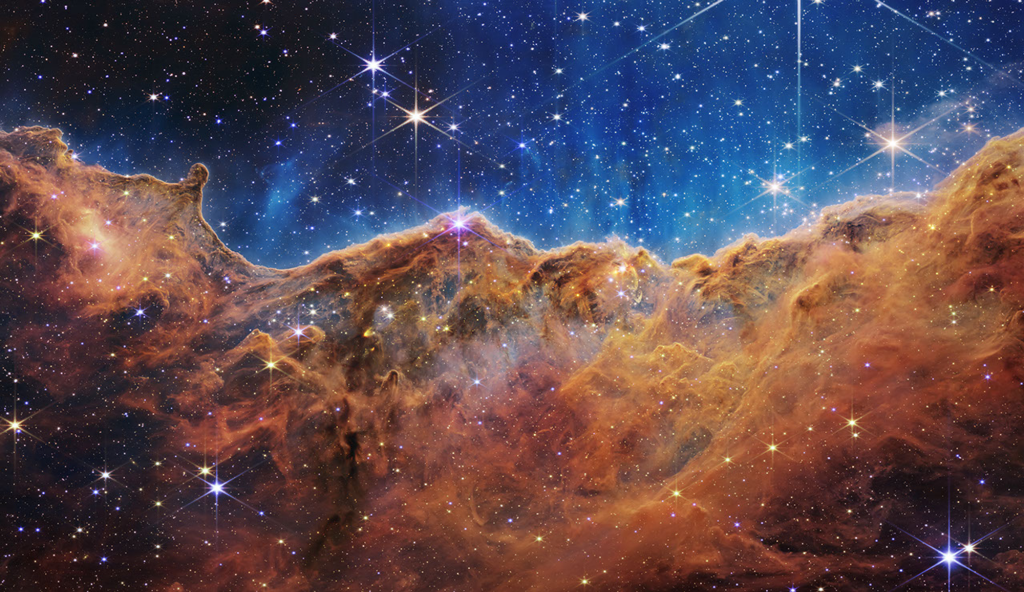
In this image NASA’s Webb Revealed Cosmic Cliffs, the Glittering Landscape of Star Birth. As we read, on the Nasa Website, “What looks much like craggy mountains on a moonlit evening is actually the edge of a nearby, young, star-forming region NGC 3324 in the Carina Nebula.” Julie Swarstad Johnson’s poem, Deep time, from the first stanza highlights the paradox of beginnings and endings coexistence. Time at cosmic scale collapses; what we see as a “beginning” (star birth) is already ancient light.
In the depths of the depths something begins,
although in truth—the simultaneous—
it’s likely already arrived at its end
the poem then equates stellar ignition with the spark of life, showing the continuum between stars and living matter: “Always far from us, sparks begin / to flare inside proteins.”
War and Peace in the New Climatic Regime
Bruno Latour, in his Facing Gaia: Eight Lectures on the New Climatic Regime (2015), conceptualizes a new idea of nature in relation to human culture, adequate to the challenges of our time by introducing a new theory of Gaia. In ancient mythology, for example in Hesiod’s Theogony, after Chaos came Gaia (Earth), the “wide-bosomed” mother who became the eternal foundation of the gods. From herself, she gave birth to Uranus (Sky) to cover her, and without any partner, she also brought forth the Mountains and the Sea (Hesiod, vv. 116-118). Latour defines Gaia as a dynamic, self-regulating, and reactive system that encompasses all the interactions between living and nonliving entities on Earth. He distances himself from James Lovelock and Lynn Margulis’s Gaia Hypothesis, by reinterpreting Gaia not as a harmonious “super-organism” but as a turbulent, contingent force and entity that resists human control and challenges anthropocentric assumptions. For Latour, Gaia is not a “whole” or a “motherly” caretaker but a patchwork of interdependent processes that collectively maintain conditions suitable for life and that are more and more unpredictable.
For this reason, it is essential to understand that Gaia does not occupy the position of arbiter that Nature occupied in the modern period. Gaia is not the “unified, indifferent, impartial, global ‘nature’ whose laws are determined in advance by the principle of causality” (238). In the Anthropocene the reactions of the Earth to human activities are multiform and in this new scenario Gaia is no longer unconcerned or indifferent to human actions and becomes “a third party in all our conflicts.” The feedback loops we receive from Gaia have now to be discovered one by one and can no longer be said neutral to our actions. This means that in the New Climate Regime “there is no longer a sovereign arbiter” and “we have to fight point by point to discover the reactions of the agents, one after another.” In the Old Climate Regime objects were de-aninated, in the new one “we find ourselves truly in a state of war.” In the old naturalist regime, Peace is given in advance based on an harmonious idea of nature, in the new “compositionist” climate regime “it has to be invented, through the establishment of a specific diplomacy” by which humans have to come to terms with a reactive and turbolent nature (ibi).

Gaia (bottom-right) rises out of the ground, pleading with Athena to spare her son (Alcyoneus), one of the Gigantes (Giants). Detail of the Gigantomachy frieze, Pergamon Altar, Pergamon Museum, Berlin.
Gaia, in Latour’s view, is fundamentally political. It is not an inert “nature” that can be mastered or subdued; instead, it actively responds to human actions, particularly in the Anthropocene, where humans have become a geological force. Gaia disrupts the separation between nature and society, compelling humans to recognize their entanglement with the Earth’s systems and their responsibilities within this interconnected web. Latour emphasizes Gaia’s agency, portraying it as a force that “acts back” in response to ecological degradation, such as climate change and biodiversity loss. This reactivity positions Gaia as a central figure in what he terms the “new climatic regime,” where politics must account for nonhuman actors.
In the seventh lecture of Facing Gaia, titled “The States of Nature between War and Peace”, Bruno Latour explores the political implications of the Anthropocene, focusing on the reconfiguration of the “state of nature” in the context of climate change. He critiques the classical “state of nature” as theorized by Hobbes, Locke, and Rousseau, which presents nature as a pre-political, passive backdrop for human activity. He argues that this conception is inadequate in the Anthropocene, where “nature” has become an active, disruptive force shaping human politics. Instead of viewing nature as a static baseline or mere resource, Latour frames it as a dynamic, contested space in which humans and non-humans are entangled.
In this perspective, he describes the Anthropocene as a time of potential war between humans and Gaia, marked by ecological instability, resource conflicts, and geopolitical tensions exacerbated by climate change. He suggests that avoiding this “war” is essential for the survival of human species and requires a radical shift in how humans relate to the Earth. This new approach entails negotiating peace not only among human societies but also between humans and the nonhuman entities that comprise Gaia. In this perspective, Latour critiques the modern conception of nation-states based on territorial sovereignty. In the Anthropocene, the boundaries of ecological processes (e.g., climate systems, water cycles) do not align with political borders. He advocates for a new kind of politics that is “earthbound,” grounded in the interconnected realities of life on Earth, and that fosters cooperation across nations and species.
Ultimately, Gaia for Latour is a call to rethink humanity’s place on Earth. It demands that humans shift from a stance of domination to one of negotiation and coexistence, engaging in what he calls “diplomacy” with Gaia. This entails a new form of politics and ethics that embrace the complexity and fragility of life on Earth, fostering a collective responsibility for the planet’s future. Through Gaia, Latour seeks to dissolve the outdated binaries of nature/society and move toward an “earthbound” perspective that aligns humanity with the ecological realities of its existence.
Bibliography
Hesiod, Theogony from The Homeric Hymns and Homerica with an English Translation by Hugh G. Evelyn-White, Cambridge, MA., Harvard University Press; London, William Heinemann Ltd. 1914.
Latour, Bruno, and Catherine Porter. Facing Gaia : Eight Lectures on the New Climatic Regime. Polity Press, 2022.
Swarstad Johnson, Julie Deep time in Scientific American Vol. 332 No. 4 (April 2025), p. 75.
Images
Detail of the Gigantomachy frieze, Pergamon Altar, Pergamon Museum, Berlin.
Gaia, Detail of the Gigantomachy frieze, Pergamon Altar, Pergamon Museum, Berlin.
Star-forming region in the Carina Nebula. Carina Nebula, NGC 3324. July 12, 2022. NASA.
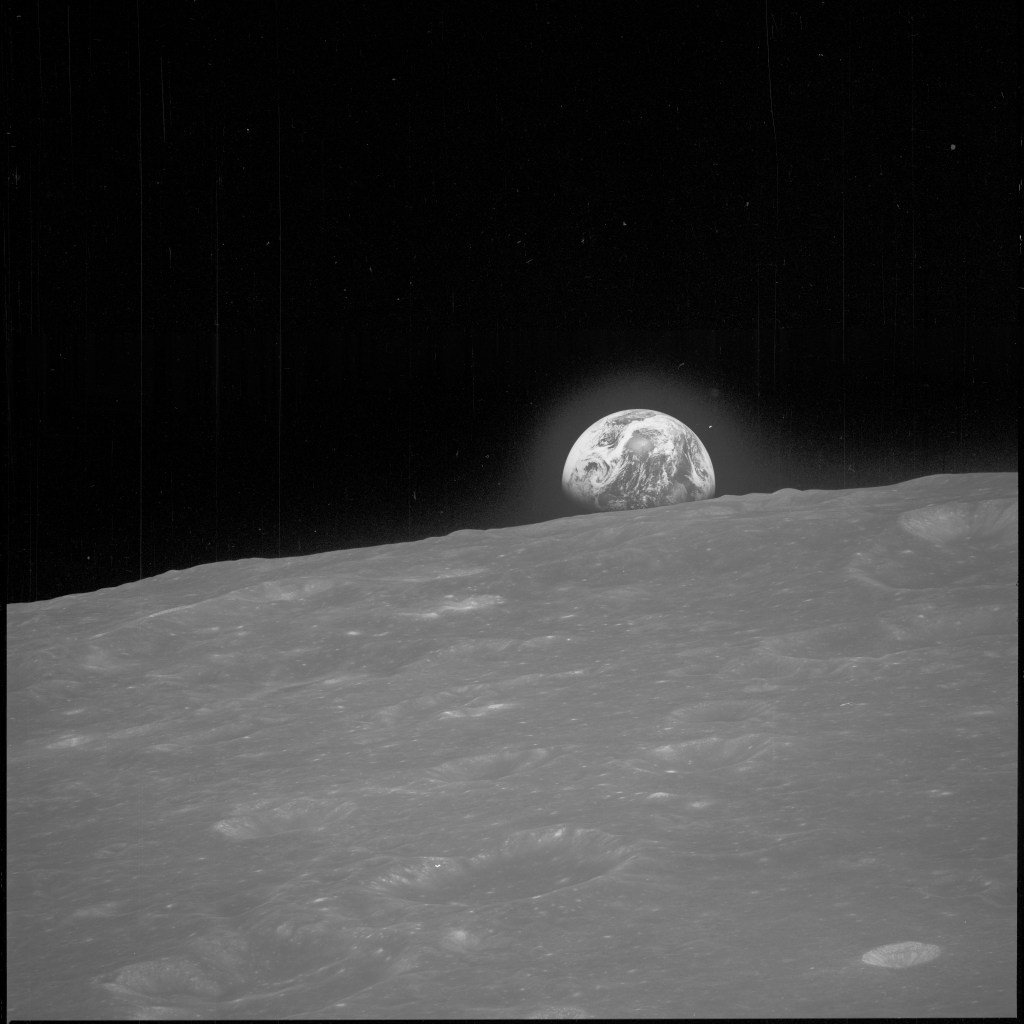
The first photograph of Earth from the Moon by a person, taken shortly before Earthrise, 21 December 1968. Image by NASA/Johnson Space Center.


 Massimo Lollini
Leave a comment