One of the most fascinating discoveries in my exploration of the Dolomites was learning that these extraordinary mountains originated in an ancient sea. The realization that their majestic peaks preserve traces of marine life dating back hundreds of millions of years filled me with wonder and brought to mind the speech of Pythagoras in Book XV of Ovid’s Metamorphoses. In illustrating his vision of a world in perpetual transformation, Pythagoras recalls having seen land that was once sea and marine shells lying far from the ocean.
What modern geology explains through the study of deep time and the movement of tectonic plates finds a remarkable poetic and philosophical resonance in Ovid’s vision of metamorphosis. The geological history of the Dolomites invites us to reconsider the apparent permanence of mountains and to recognize the dynamic, ever-changing nature of the world we inhabit.
The Discovery of the Marine Origins
The inscription of the Dolomites on the UNESCO World Heritage List in 2009 was based on two complementary criteria: their exceptional natural beauty and aesthetic importance (Criterion VII), and their outstanding geological and geomorphological significance as evidence of major stages in the history of the Earth (Criterion VIII). These two criteria are intimately connected, since the extraordinary beauty of the Dolomite landscape is itself the visible expression of a complex geological history. As early as the eighteenth century, the remarkable variety and abundance of rocks and fossils attracted the attention of naturalists and geologists, making the Dolomites an exceptional natural laboratory for the study of the Earth’s history.
From the second half of the nineteenth century, the scientific community increasingly recognized that many of the rock formations of the Dolomites originated in ancient carbonate platforms and reefs that developed in tropical seas during the Triassic, around 240 million years ago. This discovery helped explain the extraordinary shapes of these mountains and their marine origins.
Ferdinand von Richthofen (1833–1905), a collaborator of the Imperial Geological Institute in Vienna, drew on Charles Darwin’s theory of the formation and evolution of coral reefs to interpret the geological structure of the Dolomites. He was among the first to recognize that some of their imposing mountain massifs were the remnants of ancient marine reefs, subsequently transformed into rock. As David Bressan explains, Richthofen suggested that “the isolated peaks were the intact remains of an ancient reef, still surrounded by clastic sediments of an ancient ocean basin.”
Although subsequent geological research has revealed a much more complex history involving different reef-building organisms, carbonate sedimentation, volcanic activity, and tectonic processes, Richthofen’s insight represented a fundamental turning point in our understanding of the marine origins of the Dolomites.
A remarkable testimony to this ancient marine world is preserved in the Museum of Val Gardena: a fossil coral specimen from the Cipit Limestones of the Alpe di Siusi.
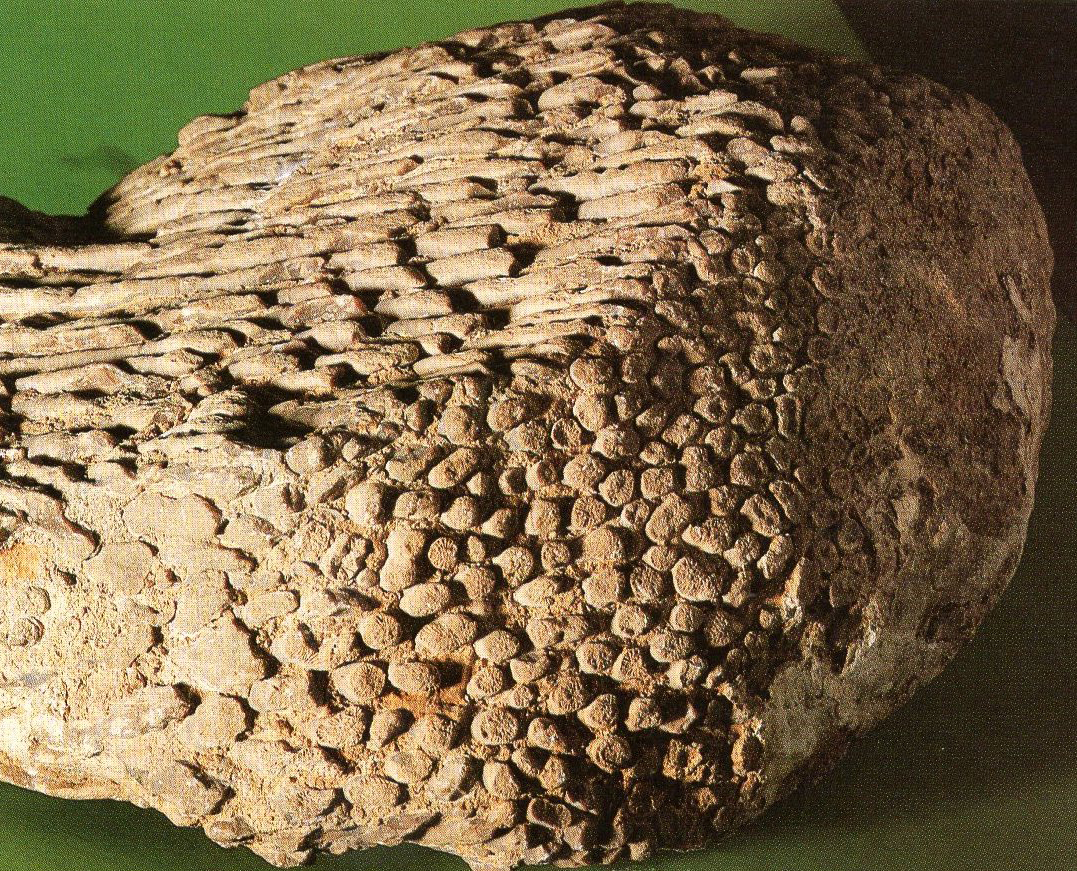
Coral Reef found in the Cipit Limestones, Alpe di Siusi
Gardena Museum
From Ancient Seas to Mountain Landscapes
The geological history of the Dolomites unfolded over hundreds of millions of years. During the Triassic, enormous quantities of carbonate sediments accumulated in the warm tropical waters of the Tethys Ocean. Much later, the convergence of tectonic plates and the Alpine orogeny uplifted and deformed these ancient marine deposits. Erosion, glaciation, and weathering subsequently sculpted them into the extraordinary mountain landscapes we see today. The Sciliar, overlooking the Alpe di Siusi, looks like a compact mass of dolomite that emerged from the bottom of the sea.
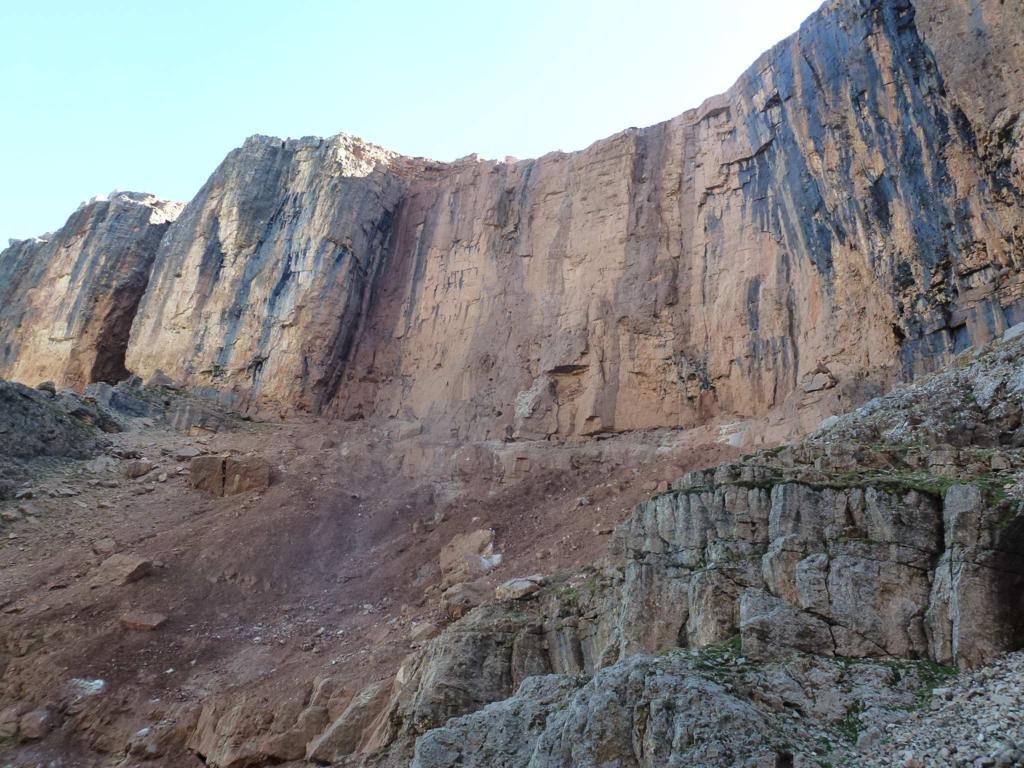
The marine environments in which these ancient reefs developed were far from static. During the Middle Triassic, intense volcanic activity profoundly affected marine ecosystems and sedimentation, leaving abundant traces in the geological record of the Dolomites. The subsequent interaction of tectonic uplift, glaciation, weathering, and erosion shaped this complex geological heritage. The different resistance to erosion of carbonate and volcanic rocks contributed to the remarkable variety of the Dolomite landscape, with its distinctive towers, pinnacles, steep cliffs, and gently undulating slopes.
The monumental and unique beauty of the Dolomites appears to be precisely linked to the dissimilar erosion of the sedimentary rocks and the vulcanoclastic rocks. In other words, “this peculiar and rare association of dark an relatively soft volcaniclastic rocks and pale, resistant dolomitic rocks is the main reason of the fantastic and spectacular Dolomite landscape” (Bosellini).
Plate Tectonics and the Evolution of Life
The formation process of the Dolomites and in general the origin of the mountains received new scientific explanations starting from the affirmation of the theory of Continental Drift elaborated at the beginning of the twentieth century by the German meteorologist Alfred Wegener. Within the framework of plate tectonics, the formation of the Alps can be understood as the result of the convergence of the African and Eurasian plates, involving the Adriatic microplate. As the intervening oceanic basins progressively closed, ancient marine sedimentary rocks were uplifted and deformed. The rocks that now constitute the Dolomites thus bear witness to a geological history that began long before the mountains themselves emerged.
Wegener’s hypothesis received substantial support in the 1960s from the exploration of the ocean floor and the discovery of seafloor spreading, leading to the development of the modern theory of plate tectonics. The new discoveries were synthesized in the late sixties in a new theory now widely accepted, the Plate Tectonics. According to this theory, the Mid-Ocean Ridge is a seafloor mountain system formed by the movement of plate tectonics.
The collision of the Indian and Eurasian plates, which gave rise to the Himalayas, provides another remarkable example of the dynamic nature of the Earth’s crust and the enormous forces involved in mountain building.
For these reasons, the Dolomites are also an exceptional natural archive of the history of life on Earth. Their geological record preserves evidence of the devastating mass extinction that occurred approximately 252 million years ago, at the end of the Permian, when the vast majority of marine species and many terrestrial species disappeared. During the subsequent Triassic period, life gradually recovered and diversified, giving rise to new ecosystems and evolutionary developments.
The Dolomites also preserve important evidence of the Carnian Pluvial Episode, a period of profound climatic and environmental change approximately 233 million years ago. Research by Massimo Bernardi, Piero Gianolla, and their colleagues suggests that this ecological crisis was closely associated with the early diversification of dinosaurs. The geological record of the Dolomites thus provides an extraordinary opportunity to explore the relationships between climate change, ecological disruption, and the evolution of life on Earth.
According to these scholars, the trace fossils found in the Dolomites play a crucial role in understanding the evolution of these great reptiles on earth. It is therefore not surprising that the fossil finds in the Dolomites are continuous and highly valuable. In this image, you may see Dinosaur footprints recently found in the Dolomites of Trento and Belluno.
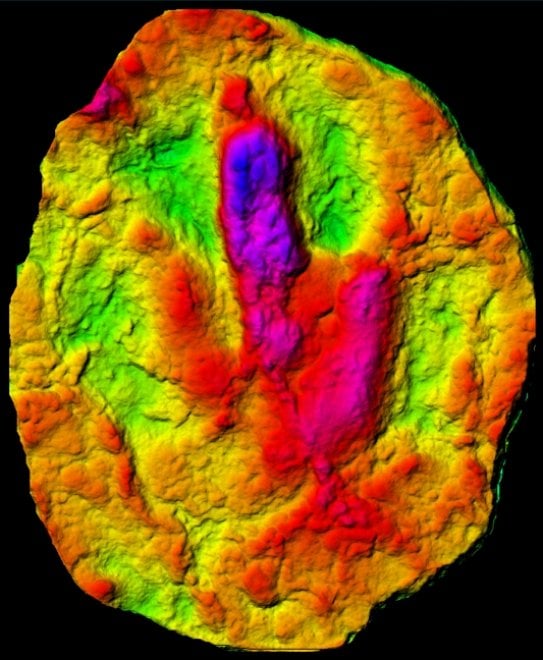
One of the oldest dinosaur footprints, found in Mezzocorona (Trento). Trento, Muse Archive.
The Discovery of Deep Time
The Dolomites offer a remarkable encounter with deep time, making visible processes that unfold on temporal scales far beyond the limits of human experience and historical memory. For me, the discovery of deep time was as profound a source of wonder as the realization that these majestic mountains originated in an ancient sea. Both discoveries have transformed my perception of the mountains, leading me to recognize their apparent permanence as a moment in the ongoing metamorphosis of the Earth.
Through the Exploring the Dolomites program, I have had the privilege of collaborating with scientists such as Evelyn Kustatscher and Elena Ghezzo, whose expertise in geology and paleontology has greatly deepened my understanding of these extraordinary processes. Their contributions have enriched my exploration of the Dolomites and strengthened my conviction that the dialogue between the humanities and the natural sciences is essential to the development of a more-than-human humanism.
Bibliography
Bernardi, Massimo, Gianolla Piero, et al. “Dinosaur diversification linked with the Carnian Pluvial Episode” Nature Communications volume 9, Article number: 1499 (2018). Web.
Belli, Gabriella. Montagna: Arte, Scienza, Mito ; Da Dürer a Warhol ; [Rovereto, Museo Di Arte Moderna E Contemporanea Di Trento E Rovereto 19 Dicembre 2003-18 Aprile 2004]. Milano: Skira, 2003. Print.
Bosellini, Alfonso. “Geology of the Dolomites”. Nomination of the Dolomites for inscription on the World Natural Heritage List Unesco. Annexes 2-8 . Belluno, Bolzano, Pordenone, Trento, Udine, 2007. Web.
Bressan, David. “The Birth of the Dolomites – Beautiful Mountains born out of the Sea”. Scientific American, June 13, 2012. Web.
UNESCO/World Heritage Convention. Web. https://whc.unesco.org/en/list/1237.

