From War Scars to Peace: Poetry and Film in the Dolomites
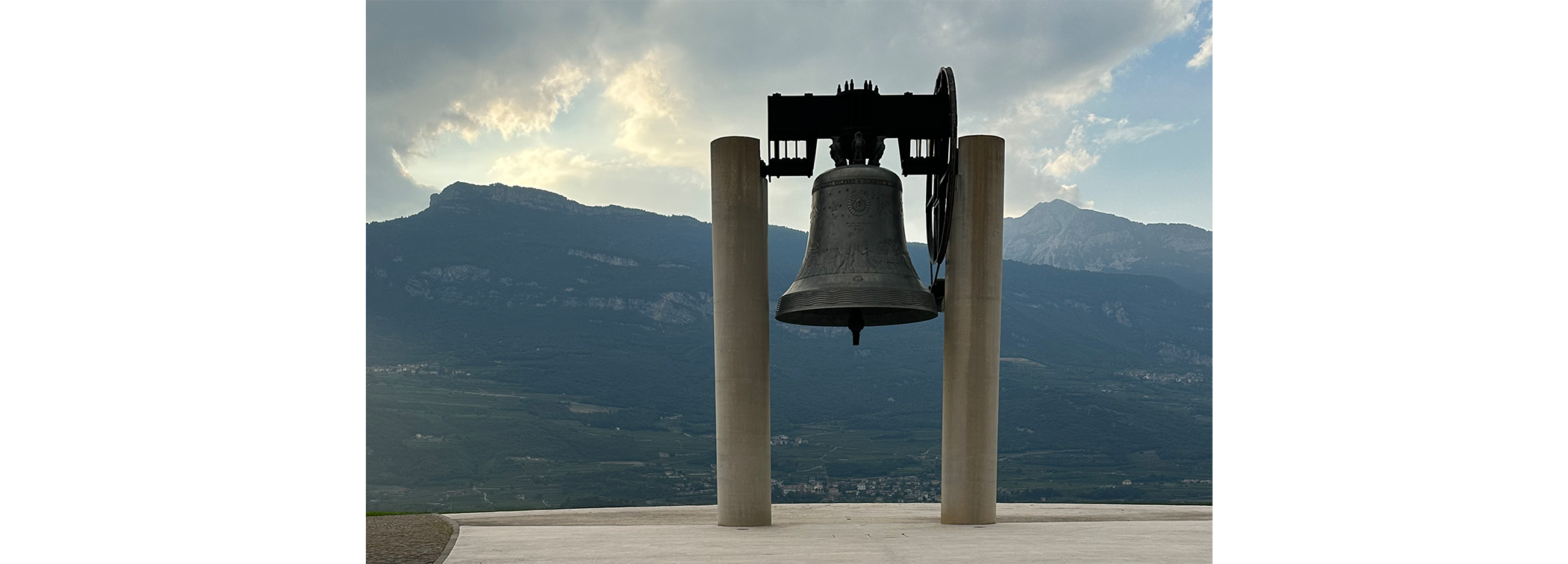
The journey of exploration of the Dolomites, which I started in 2019 with the GEO students, ends in Rovereto, a town in Trentino that, in the 20th century, was recognized as a Città della Pace, a City of Peace, thanks to its colossal bell dedicated to those who fell in the “Grande Guerra.” Yet even in this “peace” town, the traces of conflict remain visible, most strikingly in the Italian War Museum of Rovereto, housed in the Castle of Rovereto. The Great War (1914–1918) is the museum’s central focus: weapons, uniforms, soldiers’ kits, photographs, propaganda, paintings, and personal memorabilia unfold room after room, inviting us to reflect on how war and peace are inextricably intertwined in this landscape.
It offers extensive documentation not only on the military but also on the cultural and social dimensions of the First World War. The showcases display a rich collection of objects and photographs on trench warfare, flyers, posters, and testimonies from combatants and civilians. In the castle towers, one can see collections of modern weapons (XVI–XVIII) and of weapons and instruments from Prehistory to Medieval times.
In the past, the castle of Rovereto was home to Maria Dolens, the renowned Campana dei Caduti (Bell of the Fallen Soldiers, a memorial bell), now located in Colle di Miravalle. The museum still preserves the original chalk model of the Bell. On September 13, 2023, and in the following years, after their journey through the Dolomites, students shared their reflections in the evocative setting of the Bell of the Fallen. Cast from bronze from the cannons of all the nations participating in World War I, it is the world’s largest bell to sound at full peal. Every evening at dusk, its 100 tolls testify to the horrors of war and the need for world peace. In this majestic natural and historical setting, some students recited poems seeking new words of peace.
Bell of the Fallen, Rovereto. Photo by the author.
I. Poetry: Landscapes of Memory and Renewal
What follows are excerpts from the poems written by three students who participated in the 2023 journey.
Tiana Littlejohn wrote her poem “Why do these borders define me?” thinking of the “lost generation” and what the Italian soldiers must have been thinking on the WWI front lines and trenches in which we walked during our journey in the Dolomite region. She addresses the question of borders and questions their role in leading people fighting against each other without looking for a deeper and broader sense of identity:
These borders that surround me do not protect me only drown me
I see the man He sees me We scream. And I again question why on earth are we fighting And when no answers come I aim the gun I’m gripping on This has become the daily routine but that has not stopped the crying The swelling of tears blur my vision so that the human in front of me is only a dot in my vision A target An enemy in front of me Yet I will never understand why we have actually let these borders define humanity And especially why they have to define me.
They’re telling me this man in front of me is an enemy So why are they an enemy? Is it because they are ahead of me? Is it because they were born over the border And not right next to me? No, that’s not right. I know men who fight and were sharing a life with people on the same side as me What even is the same side as me?
These borders that surround me do not protect me only drown me
• • •
Camden Day, focused his poem on the importance of mountains and the natural environment for the development of human spirituality and religions:
From towering peaks to valleys deep, Many faiths in mountains find their keep. Sacred summits, where spirits soar, In the heart of nature, they adore. In every faith, a mountaintop’s grace, A symbol of hope, a sacred place. Amongst the rocks, they seek the divine, In quietude, their hearts align. So let us climb to reach the sky, Where mountains touch the heavens nigh. In their serenity, we shall find, A peaceful haven for humankind.
Camden remembers the relentless fight with nature through which farmers and shepherds colonized the mountains, conquering them for cultivation and breeding. But the mountain represents the ultimate testimony that transcends the historical conflict and the conflict to tame nature. In the last part of the poem, he underlines the possibility of learning from the past and finding inspiration in the majesty of the Marmolada:
Mount Marmolada, where echoes of strife once rang, Now stands as a testament to how hearts can change. In the shadow of conflict, a war’s bitter cost, But today, it’s a place where harmony is embossed.
Amidst the alpine beauty, a landscape so fair, Mount Marmolada now beckons, a place to repair. Where soldiers once clashed on this towering crest, Now we gather as one, to find peace and rest.
Let us learn from the past, as we stand here today, In the shadow of Marmolada, we find a new way. To share in its majesty, and in peace, we strive, A place where the beauty of life comes alive
• • •
Erik Liang wrote a poem that captured the story we learn to listen to during our journey:
In the heart of the mountains, a tale unfolds,
Of borders, conflict, stories of old.
Once war tore through these lands so fair,
And in its wake, left a border to bear.
Different cultures, a diverse blend, In a land
where languages did contend.
War’s legacy, a troubled past,
and Peace emerged. Would it last?
The question about peace remains, but in the meantime, Erik felt a sense of unity and peace, after the fears and destructions of the war:
From battles fought on mountain high, To the negotiations over common ground, The Marmolada’s story we now share Of a region that learned to love and care.
Autonomy brought a brighter day, Where many cultures found their way. No longer torn by the wars of long ago, In unity, they thrive and soar.
Germans, Italians, all reside, In harmony, side by side. Their languages, a chorus of sound, In peace, their shared home is found.
So let us cherish this history, Of a region where peace has replaced fear. Where once was conflict, now we see, A land where cultures coexist in glee.
• • •
The following poem, Redemption: Life and Death in the Dolomites, by Acacia Raine Czuk, offers a particularly compelling example of how poetic imagination can illuminate the complex relationship between human history and the natural world.. Written in response to the 2026 program, it brings together the memory of the First World War, the material traces of violence in the mountains, the retreat of glaciers, and the persistence of life in a landscape marked by destruction and renewal. It provides a fitting conclusion to this selection of student poetry, reminding us that the Dolomites are not merely objects of scientific investigation or historical interpretation, but also places that invite ethical reflection, imagination, and personal transformation.
I watch the clouds fold over your peaks falling into the valley below where a stream bubbles over boulders and rubs against muddy banks.
I imagine tired muddy boots trudging through with rifled shoulders heavy hung— The war long gone, goes on.
My eyes trace the jagged lines of your limestone cliffs austerity now humbled, scarred, crumbled carved out your body torn apart into scattered stones.
I stumble across the white rubble into dank gloom as I enter the vestibule of your hollowed hallows— with each exhausting step I breathe your breath. So many steps so much to overcome— the effects of war can never be undone.
But then again, as I emerge I see your pale white facade once stained with blood, now washed clean by soft and violent rain and trees swept over your terrain regrow.
Scars remain.
I touch your scars, where green grass, velvet moss, and flowers flourish into the tunnels and the crevices, they paint your wounds climbing up and into your Dolomite skin.
From here I witness the grandeur melting from your highest peaks where the City of Ice can no longer be conceived, where two hundred men lived within, soon you will be without.
And as I turn my gaze to the soft valley below, a tarnished tombstone rests upon a pile of limestone rubble. Where one soldier rests, yet thousands more are gone.
As death brings life, just beyond three tall, plump alpine sheep with flopping ears wander into the valley, matted wool weaving between your jagged limestone walls, over mountain meadows towards the bubbling stream.
II. From Poetry to Film
Poetry is only one of the many forms through which students respond creatively and critically to their experience of the Dolomites. Their final projects include essays, photographic narratives, short films, and multimedia presentations, reflecting the diversity of their interests and ways of engaging with the landscapes, histories, and ideas encountered during the program.
These creative projects emerge from an interdisciplinary experience that brings together geology, ecology, history, literature, and philosophy. Through disciplinary assignments and reflective exercises, students are encouraged to explore not only each field’s distinctive contributions but also the connections and tensions among them. The aim is not simply to bring different disciplines together, but to discover how their interaction can transform our understanding of a landscape in which natural and human histories are deeply intertwined.
Sam Schwalbach’s From Trenches to Trails offers a particularly compelling cinematic expression of this interdisciplinary encounter. The movement from destruction to renewal evoked in Acacia’s Resurrection finds a complementary expression in Sam Schwalbach’s short film From Trenches to Trails. Moving from poetic reflection to cinematic exploration, the film invites us to consider how a landscape once marked by violence and destruction can become a place of remembrance, reconciliation, and renewed engagement with the natural world.
From Trenches to Trails — A Short Film by Sam Schwalbach (2026)
Created as part of Exploring the Dolomites 2026, Sam Schwalbach’s short film juxtaposes historical footage of World War I with contemporary images of the same mountain landscapes. Moving from the logic of military conquest to an ethic of attentive engagement with the natural world, the film draws on the Himalayan greeting kalipè, which encourages travelers to walk at a short, slow, and steady pace.
More than a recommendation for how to walk, kalipè expresses a different relationship with the mountains: rather than seeking to conquer them through speed and force, we allow ourselves to be transformed by the experience. Through this shift in perspective, former battlefields become places of remembrance, encounter, and peaceful coexistence, and the mountains emerge not merely as witnesses to human history but as teachers of a different way of inhabiting the world.
Peace as Practice
Together, Acacia’s poem Resurrection and Sam’s film suggest that peace is more than the absence of war. It is an ongoing practice of remembrance, care, and renewed attention to the world we share. What once served as a landscape of destruction can become a place where new relationships between human beings, history, and nature begin to take shape.